Tour overview
- Tour Code
- CN-XA-005
- Rating
- 4.9
- Duration
- 3 Days
- Destination
- Xi'an
- Tour Type
- Private for you only
- Suitable For
- China Culture Lovers
Starting from
$518 p.p
A private tour based on a stay in a 4-star hotel with double occupancy. The price is subject to the travel dates, the number of people, and the selected hotel.
Highlights
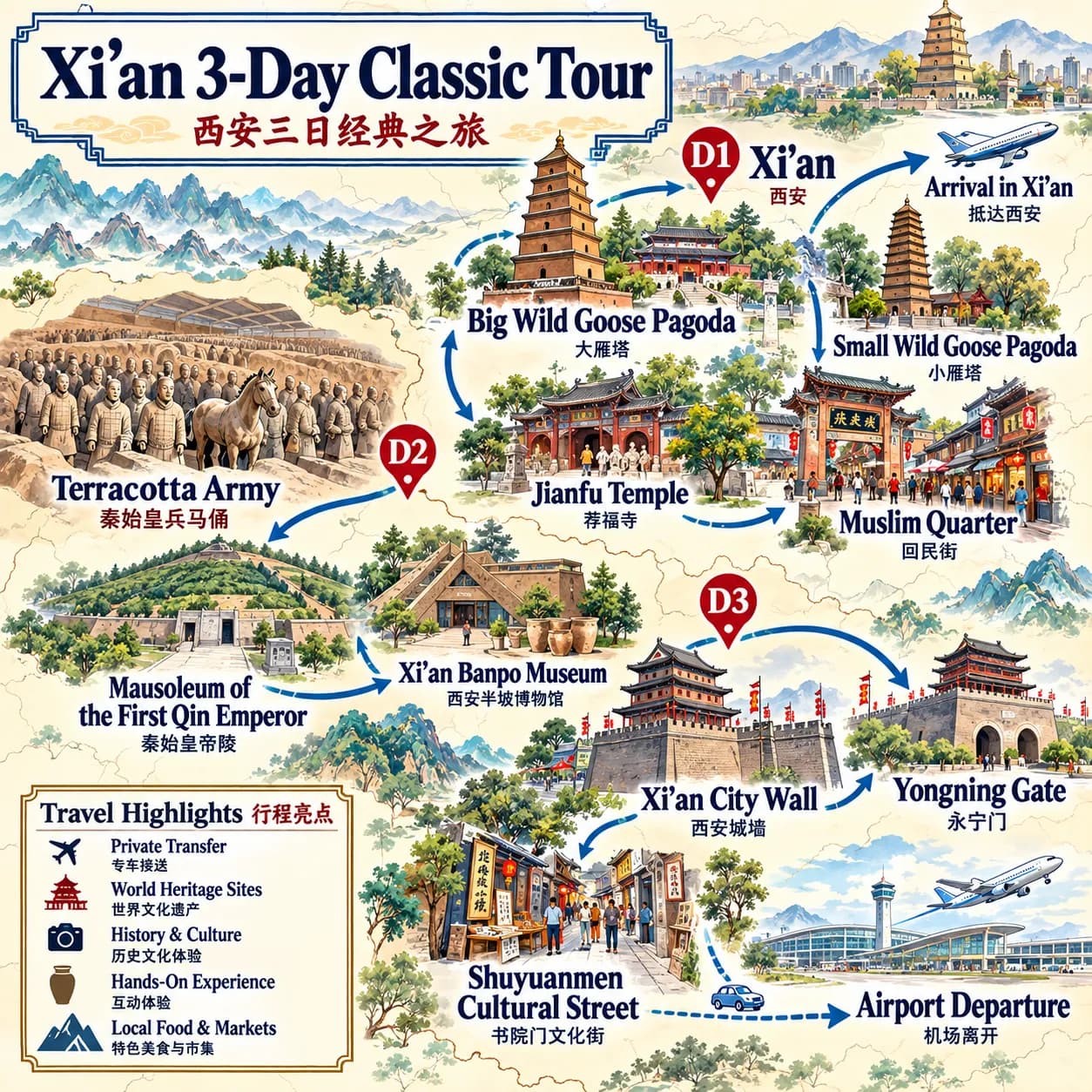
3-day Xi'an private tour: Covers key spots—Big/Small Wild Goose Pagoda, Qinshihuang's Mausoleum, Xi'an City Wall. Pro explanations & audio guide included for some attractions.
Convenient transfers: Free airport pick-up ; private car to airport on Day 3. Hotel pick-ups on Days 2-3 for smooth travel.
Diverse experiences: Explore Muslim Quarter, Shuyuanmen Culture Street ; lunch self-paid. Mixes history, culture & local vibes.
Your experience
Itinerary & tour details
Welcome to Xi’an, one of China’s most celebrated ancient capitals and a city renowned for its imperial history, Buddhist heritage, and vibrant traditional neighborhoods. Upon arrival at Xi’an Xianyang International Airport, meet your local guide, who will contact you in advance with the pick-up details. Look for the name sign at the agreed meeting point and enjoy a comfortable transfer into the city to begin your cultural exploration.
Your first destination is the Big Wild Goose Pagoda, one of Xi’an’s most iconic historical landmarks and an enduring symbol of the Tang Dynasty. Originally constructed in the seventh century, the pagoda is closely associated with the Buddhist monk Xuanzang, who traveled to India to obtain Buddhist scriptures and later devoted himself to translating these texts into Chinese. The site played an important role in the preservation and transmission of Buddhist teachings throughout China.
Explore the surrounding cultural complex and admire the pagoda’s distinctive brick architecture, symmetrical proportions, and traditional design. With professional explanations from your guide, learn about the historical significance of the monument, the development of Buddhism during the Tang Dynasty, and Xi’an’s position as a major center of cultural exchange along the ancient Silk Road. The surrounding landscaped areas also provide excellent opportunities for photography and a relaxing walk.
Continue to the Small Wild Goose Pagoda, another important Buddhist monument that reflects the religious and architectural achievements of the Tang Dynasty. Although smaller in scale than its more famous counterpart, the pagoda has considerable historical value and offers a quieter atmosphere in which to appreciate Xi’an’s Buddhist heritage.
Discover how the pagoda was associated with the translation and preservation of Buddhist scriptures, helping establish Xi’an as an important center for religious scholarship. Observe its traditional brick structure and elegant silhouette, and learn how historical events and natural forces have shaped the monument over the centuries. The surrounding grounds provide a pleasant setting for exploring the city's cultural past away from the busiest commercial areas.
Proceed to Jianfu Temple, the historic Buddhist temple closely associated with the Small Wild Goose Pagoda. Explore the designated temple grounds and appreciate the traditional architecture, courtyards, and peaceful surroundings. Your guide will introduce the temple's historical development and explain its connection with Buddhist practice and the cultural life of ancient Chang’an, the former name of Xi’an during several imperial periods.
As you walk through the temple area, discover how religious institutions contributed to education, literature, artistic development, and international exchange in ancient China. The temple visit provides a deeper context for understanding the pagodas and their significance beyond their architectural beauty. Please observe local rules regarding appropriate behavior, photography, and access to active religious spaces.
In the afternoon or early evening, continue to the Muslim Quarter, also known as Huifang, one of Xi’an’s most famous cultural and culinary districts. The neighborhood reflects the city's long history of trade and cultural interaction, including connections with merchants and travelers along the Silk Road. Its lively streets feature traditional food stalls, specialty shops, bakeries, and small restaurants serving a wide variety of local dishes.
Stroll through the bustling lanes and discover the distinctive flavors of Shaanxi cuisine. Depending on your preferences, you may wish to sample roujiamo, hand-pulled noodles, lamb dishes, savory pancakes, or traditional pastries. Your guide can help introduce the area's food culture and point out notable local specialties, while all food purchases remain at your own expense.
Take time to explore the traditional streets, browse local products, and observe the lively atmosphere as the neighborhood becomes busier toward evening. The Muslim Quarter is an excellent place to experience Xi’an beyond its monuments, offering a combination of culinary traditions, historic streets, and everyday local life.
After the day's sightseeing, travel back to your hotel according to the arranged transfer service. If your flight arrives later than expected, the sightseeing order or duration may be adjusted to ensure a comfortable pace and sufficient time for each attraction.
Meals: All meals are self-arranged and at your own expense.
Transportation: Airport pick-up, local sightseeing transfers, and return transfer to the hotel according to the confirmed arrangements.
Accommodation: Xi’an
After breakfast, meet your guide and driver at the hotel for a full day exploring two important archaeological sites that reveal different chapters of ancient Chinese civilization. Today's itinerary combines the military and political achievements of the Qin Dynasty with the much earlier Neolithic settlements of the Guanzhong region, providing a fascinating overview of Xi’an's history across thousands of years.
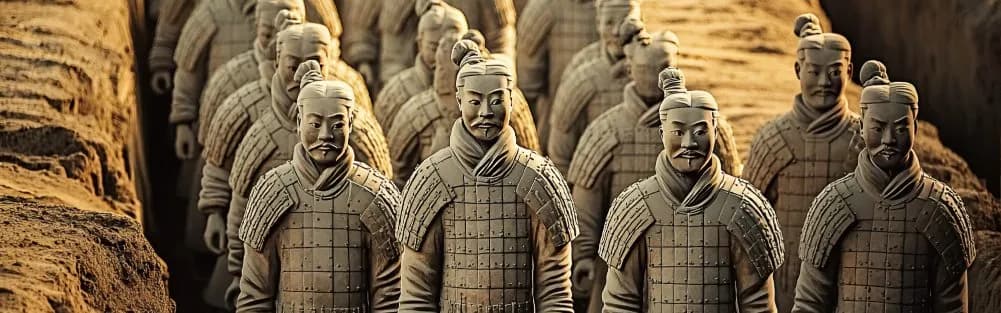
Begin with a journey to the Emperor Qinshihuang’s Mausoleum Site Museum, home to the world-famous Terracotta Army. This extraordinary archaeological complex was created for Qin Shi Huang, the first emperor to unify China in the third century BCE. The vast mausoleum project reflects the emperor's extraordinary political power and the ancient belief that an imperial ruler would continue to require protection and authority in the afterlife.
Upon arrival, explore the principal excavation pits with professional explanations and the included audio-guide arrangements. Observe the remarkable rows of life-sized terracotta warriors, horses, and chariots, many of which were buried underground for more than two thousand years. The figures were arranged in military formations, providing valuable insight into the organization, equipment, and hierarchy of the Qin imperial army.
As you move through the exhibition areas, pay attention to the individual details of the warriors. Their facial expressions, hairstyles, armor, and clothing vary, demonstrating the remarkable craftsmanship of the artisans who created them. Learn how the discovery of the Terracotta Army in the 1970s transformed archaeological understanding of the Qin Dynasty and revealed the extraordinary scale of the emperor's funerary complex.
Continue exploring the designated museum areas to understand the relationship between the Terracotta Army and the broader mausoleum site. Your guide will introduce the historical background of Qin Shi Huang's unification of China, the development of imperial administration, and the role of the mausoleum in expressing imperial authority. The audio guide can provide additional explanations as you move between the exhibits at your own pace.
Allow sufficient time to appreciate the scale of the excavation pits and the ongoing preservation work. The museum is extensive and can be busy during weekends and public holidays, so comfortable walking shoes and advance ticket arrangements are recommended. Please follow the museum's visitor instructions and observe any restrictions on photography.
After the Terracotta Army visit, enjoy lunch independently at a local restaurant. You may choose from regional Shaanxi dishes, noodle restaurants, or other convenient dining options near the attraction or along the return route. Lunch is not included, allowing you to select a meal according to your preferences and schedule.
In the afternoon, continue to the Xi’an Banpo Museum, an important archaeological museum built around the remains of a Neolithic settlement dating back approximately six thousand years. Banpo provides a fascinating contrast with the imperial history of the Terracotta Army, offering insight into the lives of early communities that lived in the region long before the emergence of China's dynastic states.
Explore the archaeological site and museum exhibitions to discover the settlement's layout, including residential areas, storage facilities, craft spaces, and burial grounds. The remains help illustrate how early communities organized their daily lives, developed agricultural practices, produced pottery, and adapted to their natural environment.
Examine the pottery, tools, ornaments, and other archaeological objects that reveal the skills and traditions of Banpo's inhabitants. Some pottery features distinctive painted patterns and geometric designs, reflecting the development of early artistic expression. The exhibits also provide clues about food preparation, social organization, and the relationship between settlement life and the surrounding landscape.
As you explore the museum, consider the contrast between Banpo's early farming community and the highly centralized Qin Empire represented by the Terracotta Army. Together, these sites reveal the remarkable transformation of Chinese society from prehistoric villages to one of the world's earliest imperial civilizations.
After completing the museum visit, return to Xi’an by private vehicle. Depending on traffic conditions and the day's schedule, you may have time to relax at your hotel or enjoy an independent evening in the city. Consider sampling additional local specialties or taking a leisurely walk near your accommodation before the final day of sightseeing.
Meals: Breakfast depends on your selected hotel; lunch is self-arranged and at your own expense. Dinner is not included unless otherwise specified.
Transportation: Hotel pick-up, private sightseeing transfers between the Terracotta Army and Banpo Museum, and return transfer to the hotel.
Accommodation: Xi’an
Enjoy breakfast at your hotel before checking out and meeting your driver for the final day of your Xi’an journey. Today's itinerary focuses on the city's historic fortifications and traditional cultural streets, providing a final opportunity to appreciate Xi’an's architectural heritage and local atmosphere before your transfer to the airport.
Begin at the Xi’an City Wall, one of China's largest and best-preserved ancient city fortifications. The existing wall was extensively developed during the Ming Dynasty and continues to surround the historic urban center. Its imposing brick ramparts, defensive gates, watchtowers, and broad elevated pathways illustrate the importance of urban defense in traditional Chinese city planning.
Explore the area around Yongning Gate, also known as the South Gate, one of the most prominent and recognizable entrances in the city wall system. Admire the massive gate structures and carefully designed defensive features while learning about the wall's role in protecting Xi’an and controlling access to the historic city.
Depending on your available time and ticket arrangements, you may walk along an accessible section of the wall to enjoy views of the old city and the modern skyline beyond it. The elevated ramparts offer excellent photographic opportunities and reveal the contrast between the ancient fortifications and Xi’an's contemporary urban development. Travelers who wish to cycle along the wall may consider this as an optional activity, subject to operating conditions and additional charges.
Continue to Shuyuanmen Cultural Street, a traditional cultural district known for its calligraphy, Chinese painting, brushes, inkstones, paper, and other arts and crafts. The street provides an introduction to the scholarly traditions that have shaped Chinese culture for centuries and offers a quieter atmosphere after exploring the city wall.
Stroll past traditional-style storefronts and admire the architecture inspired by historic streets and courtyard buildings. Browse shops displaying calligraphy works, paintings, decorative objects, and handcrafted souvenirs. If you are interested in Chinese writing or traditional art, this is an excellent place to observe the tools and materials used by calligraphers and painters.
Learn about the importance of calligraphy in Chinese education, literature, and artistic expression. The district's atmosphere reflects the traditional relationship between scholarship and the arts, offering a different perspective on Xi’an's heritage beyond its imperial monuments and archaeological sites.
Take some time to browse for souvenirs or purchase a small memento of your visit, such as a calligraphy brush, a piece of traditional artwork, or a locally made craft. Shopping is optional and at your own expense. Depending on opening hours and your departure schedule, you may also enjoy a short break at a nearby café before leaving the historic center.
After the cultural street visit, meet your driver for the scheduled private transfer to Xi’an Xianyang International Airport. Please reconfirm your flight time, terminal information, and pick-up arrangements in advance. As the airport is located outside the central urban area, allow sufficient time for traffic, check-in, baggage drop-off, and security procedures.
If your flight departs early, the sightseeing schedule may need to be shortened to ensure a timely airport arrival. If you have a later departure, you may have additional time to explore the cultural street or enjoy a final meal independently before your transfer.
Your three-day journey through Xi’an concludes with a memorable combination of Tang Dynasty Buddhist landmarks, the world-famous Terracotta Army, prehistoric Banpo culture, ancient city fortifications, and traditional Chinese arts. These experiences provide a broad perspective on the city's development across thousands of years of Chinese history.
Meals: Breakfast depends on your selected hotel; lunch is self-arranged and at your own expense. Other meals are not included unless specified.
Transportation: Hotel pick-up, sightseeing transfers, and private transfer to Xi’an Xianyang International Airport according to the confirmed arrangements.
Departure arrangements: Confirm the airport transfer time and destination with your driver or tour provider. Please keep your identification document and flight details accessible.
Your journey, simplified
How We Work
From the first idea to the final day, every detail is handled with care.
Share your travel ideas
Tell us where you want to go and what you enjoy.
Meet your travel advisor
We shape a personal itinerary around your priorities.
Confirm your journey
Review every detail and reserve with confidence.
Travel with support
Our team stays available throughout your trip.
Travel expert
Contact Your Travel Specialist
Get practical advice from a local specialist and turn this route into a trip that fits you.
Start planningRelated Articles
Swipe to explore