Forbidden City Travel Guide: Tickets, Hours, Transportation & Must-See Halls
As a traveler who’s wandered through some of the world’s most iconic palaces,I can confidently say the Forbidden City(known as Gugong in Chinese,or Zijin Cheng—“Purple Forbidden City”—in its traditional name)isn’t just a UNESCO World Heritage Site—it’s a living,breathing piece of China’s soul.With over 600 years of history,this architectural marvel was home to 24 emperors of the Ming and Qing dynasties,standing proudly alongside global treasures like France’s Palace of Versailles,London’s Buckingham Palace,Washington D.C.’s White House,and Moscow’s Kremlin as one of the world’s top five ancient palatial complexes.What makes it truly unforgettable?Its perfect symmetrical design,the pinnacle of classical Chinese architecture,and a collection of imperial treasures that tell stories of emperors,concubines,and a bygone era of power and elegance.Whether you’re a history buff,an architecture lover,or just someone seeking to immerse yourself in China’s rich culture,the Forbidden City is a must-visit—and this guide will help you plan every detail.
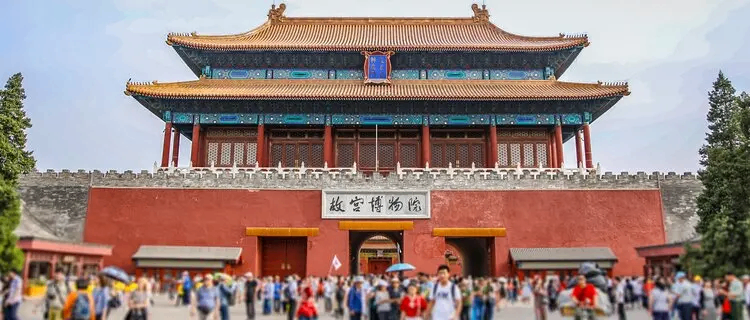
Let’s start with the name:“Forbidden City”isn’t just a dramatic title.For centuries,common citizens were barred from entering without imperial permission,and even those who lived within its walls—emperors’wives,servants,and officials—couldn’t leave freely.Many spent their entire lives within these grounds,never stepping outside.The“purple”in its Chinese name,Zijin Cheng,is a nod to Polaris,the North Star—revered in Chinese astro-mythology as the abode of the Celestial Emperor,making the palace a terrestrial reflection of heaven.It’s a small detail that adds layers of mystery to an already fascinating place.
Building this imperial residence was no small feat:construction took 14 years,from 1406 to 1420,and over the centuries,it weathered fires,wars,and reconstructions—yet still stands as a testament to China’s ancient engineering and artistic genius.Spanning over 720,000 square meters(about 180 acres)with more than 8,000 rooms,it’s a sprawling complex surrounded by a 10-meter-high city wall and a 52-meter-wide moat,forming a fortified rectangular castle that feels both imposing and serene.The layout is meticulously planned,with four gates(north,south,east,west)and two main sections:the Outer Court and the Inner Palace.
The Outer Court(Wai Chao)is where the emperor conducted state affairs and held grand ceremonies—think coronations,weddings,and imperial examinations.Its three main halls are the crown jewels of the Forbidden City:the Hall of Supreme Harmony(Tai He Dian),the tallest and most magnificent structure,where emperors ascended the throne;the Hall of Middle Harmony(Zhong He Dian),a quiet resting place for the emperor before ceremonies;and the Hall of Preserving Harmony(Bao He Dian),where feasts were held and the highest imperial exams took place.These halls are adorned with intricate carvings,golden roofs,and red pillars—colors and designs that symbolize imperial power and prosperity.Don’t rush through them:take a moment to admire the details,like the dragon motifs(a symbol of the emperor)and the massive stone slabs that were transported here centuries ago.
Behind the Outer Court lies the Inner Palace(Nei Ting),the private realm of the emperor and his family.Here,the architecture shifts from grand and ceremonial to warm and livable,with courtyards,gardens,and intimate palaces.The core of the Inner Palace is three main buildings:the Palace of Heavenly Purity(Qian Qing Gong),where the emperor lived and handled daily affairs;the Palace of Union and Peace(Jiao Tai Dian),which housed the imperial seals;and the Palace of Earthly Tranquility(Kun Ning Gong),the empress’s residence.Surrounding these are the Six Eastern Palaces and Six Western Palaces,where concubines and other family members lived.Walking through these halls,you can almost imagine what life was like for the imperial family—far from the formality of the Outer Court,it’s a glimpse into their private joys and sorrows.
Now,let’s get to the practical details you need to plan your visit.First,tickets:the Forbidden City operates on a high and low season schedule.From April 1 to October 31(high season),tickets cost 60 CNY;from November 1 to March 31(low season),they drop to 40 CNY.Two popular add-ons are the Hall of Clocks and the Treasure Gallery,each costing an extra 10 CNY—and trust me,they’re worth it for the rare artifacts you’ll see.Opening hours also vary by season:in high season,it’s open from 8:30 AM to 5:00 PM(last ticket sold at 4:00 PM);in low season,it closes a bit earlier,from 8:30 AM to 4:30 PM(last ticket sold at 3:30 PM).Pro tip:arrive early to beat the crowds—this place gets busy,and the morning light is perfect for photos!
Getting to the Forbidden City is easy,thanks to Beijing’s efficient public transport.By bus,take lines 1,2,52,59,82,99,120,or Tourist Lines 1/2 to Tiananmen East Station,or lines 1,5,52,99,or Tourist Lines 1/2 to Tiananmen West Station.By subway,take Line 1 to Tiananmen East Station(Exit A)or Tiananmen West Station(Exit B)—both are a short walk to the entrance.Important:you can only enter through the Meridian Gate(Wu Men),the southern gate,and exit through either the Gate of Divine Prowess(Shenwu Men,the northern gate)or the Gate of Eastern Brilliance(Donghua Men).Make sure to plan your route accordingly to avoid backtracking.
Before you go,there are a few key things to note.You’ll need to register on the Beijing Health Kit app to get a Beijing Health Code,and you may be required to show a negative PCR test result within 72 hours(check the latest requirements before your trip,as regulations can change).Also,since the Forbidden City is a large complex,wear comfortable shoes—you’ll be walking a lot!If you want to dive deeper into the history,consider joining a guided tour:our popular options include a half-day bus tour of the Forbidden City and Treasure Museum,a 1-day private tour combining the Forbidden City with the Temple of Heaven,or a 4-day classic Beijing private tour that covers all the city’s highlights.We also offer special add-ons,like experiencing traditional Chinese folk art(think paper-cutting)in a hidden spot—just let us know if you want to add that to your itinerary.
The Forbidden City isn’t just a tourist attraction;it’s a window into China’s past.Every corner,every hall,and every artifact has a story to tell—of emperors and empresses,of artisans and servants,of a civilization that has endured for millennia.Whether you’re marveling at the symmetry of the architecture,gazing at a priceless imperial treasure,or simply wandering through a quiet courtyard,you’ll feel a connection to history that’s hard to find anywhere else.So pack your curiosity,grab this guide,and get ready to explore one of the world’s most extraordinary places—you won’t regret it.
Questions?
-
Email
zhanwenjuan@lingshicha.net
-
WhatsApp