How to Pay in China 2026: A Tourist’s Ultimate Guide to Going Cashless (and Avoiding Headaches)
Let me tell you a little story first. On my first trip to China back in 2018, I showed up with a fat wallet full of cash and a stack of credit cards, thinking I was all set. Then I tried to buy a steaming bowl of street noodles for breakfast—and the vendor just stared at me, pointed at a tiny QR code sticker on his cart, and shook his head. I stood there, confused and hungry, while a local girl whipped out her phone, scanned the code in two seconds, and walked away with her noodles. That’s when I realized: in China, cash is basically a relic, and mobile payment is king.
If you’re planning a trip to China in 2026, you don’t want to be the confused tourist holding cash at a street stall. This guide isn’t just a list of steps—it’s everything I’ve learned from years of fumbling through payments, making mistakes, and finally paying like a local. By the end, you’ll be scanning QR codes like a pro, no stress required.
The Big Truth: China Is a Cashless Society (Really)
Here’s a stat that might blow your mind: around 80% of daily transactions in China are done via mobile payment. Let that sink in. We’re talking about everything—from a ¥5 ice cream cone to a ¥5,000 shopping spree at a mall. You’ll see QR codes everywhere: on taxi dashboards, at restaurant tables, even on the little baskets at fruit stands.
The two giants here are WeChat Pay and Alipay—these aren’t just payment apps, they’re super apps that run people’s lives. WeChat is like WhatsApp, Venmo, and your bank app rolled into one. Alipay is more focused on payments and financial services, kind of like a souped-up PayPal. The best part? Both now let you bind your foreign bank card, no Chinese phone number required (well, mostly—more on that later).
A quick heads-up before we dive in: your home bank might charge foreign transaction fees, and exchange rates can fluctuate. Do yourself a favor and call your bank before you leave. Ask about overseas transaction fees, currency conversion rates, and whether they block payments to Chinese apps (some banks do this to prevent fraud). Trust me—this 5-minute phone call will save you from nasty surprises on your bank statement.
How to Use WeChat Pay as a Tourist (Step-by-Step, No B.S.)
Let’s start with WeChat Pay, because it’s the one you’ll use everywhere—from buying street food to splitting a bill with new friends.
Step 1: Download WeChat (and Yes, It’s Called Weixin in Chinese) You can grab WeChat from the App Store or Google Play—easy peasy. If you search in China, you’ll see it listed as “Weixin” (that’s the Chinese pronunciation). Don’t panic—it’s the same app. Pro tip: download it before you arrive in China. Sometimes app stores in other countries have restrictions, and you don’t want to waste your first day in Shanghai messing with downloads.
Step 2: Sign Up for an Account (Two Easy Ways) Here’s the good news: you don’t need a Chinese phone number anymore. WeChat now lets tourists sign up with either a foreign mobile number or a Facebook account. No passport required for basic registration—but you’ll need it later to bind your card, so keep it handy. If you use a foreign phone number: Enter your number, wait for the SMS verification code (it might take a minute or two—be patient), type it in, and you’re done. If you use Facebook: Tap “Sign up with Facebook,” log in, and follow the prompts. Super straightforward.
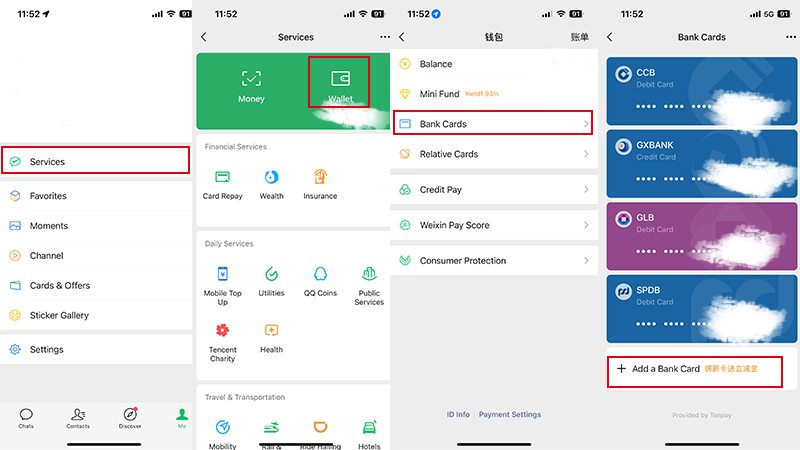
Step 3: Bind Your Foreign Card (Visa, Mastercard, Etc.) This is the magic step that turns WeChat from a messaging app into your payment lifeline. Here’s how to do it: 1. Open WeChat and tap the Me tab at the bottom right. 2. Select Services (if you don’t see it, check your settings—sometimes it’s hidden for new accounts). 3. Tap Wallet, then Bank Card. 4. Enter your card number (Visa, Mastercard, American Express, JCB, Diners Club, and Discover all work—thank goodness). 5. Follow the on-screen instructions to verify your card. You might need to enter your name (as it appears on the card) and passport number here. A quick warning: some tiny local shops (think family-run noodle joints or fruit stalls) might not accept foreign card payments via WeChat Pay. Why? Because they only use the “domestic” version of WeChat Pay, which doesn’t process international transactions. It’s rare, but it happens—so keep a small amount of cash on hand just in case (¥200–¥300 is enough).
Step 4: Pay Like a Local (Two Methods, Both Simple) There are two ways to pay with WeChat Pay—you’ll use both depending on the situation: 1. Scan the merchant’s QR code: Open WeChat, tap the + button at the top right, select Scan, point your phone at the merchant’s QR code, enter the amount, and tap “Pay.” Done. 2. Show your payment code to the merchant: Go to Services > Wallet > Payment Code (you might need to enter a password or use Face ID to unlock it). Hold your phone up to the merchant’s scanner, and it will charge your card automatically. No typing required—perfect for busy places like subway stations or coffee shops.
How to Use Alipay in China 2026 (Including the Lifesaver TourCard)
Alipay is the other big player, and it’s especially great for tourists because of its TourCard feature (more on that in a second). If WeChat is for casual, everyday payments, Alipay is for when you need a little extra flexibility—like paying at a market that doesn’t accept foreign cards.
Step 1: Download Alipay (Get the International Version!) First things first: make sure you download the Alipay International Version. The regular Chinese version is for people with Chinese bank accounts, and it won’t work with your foreign card. You can find the international version on the App Store or Google Play—just search “Alipay International.”
Step 2: Register Your Account (Email or Phone Number Works) Unlike WeChat, Alipay lets you sign up with either a foreign phone number or an email address. No Chinese SIM card needed—hallelujah. Just enter your details, verify with a code (SMS or email), and you’re set. Easy as pie.
Step 3: Bind Your Foreign Card (Same as WeChat, But with Extra Perks) Binding your card to Alipay is almost identical to WeChat Pay: 1. Tap the Me tab, then Bank Cards. 2. Enter your card number and follow the verification steps (passport info might be required here too). 3. Once it’s bound, you can use Alipay to pay at most places—just like WeChat. But here’s where Alipay shines: the TourCard mini-program.
Step 4: Use Alipay TourCard (For When Your Foreign Card Fails) Let’s say you’re at a tiny village market, and the vendor’s Alipay doesn’t accept international transactions. Or maybe your card won’t bind for some reason. Enter TourCard—a lifesaver for tourists. It’s a mini-program run by the Bank of Shanghai that lets you load Chinese Yuan (CNY) onto a virtual card, so you can pay like a local even if your foreign card is out of the picture. Here’s how to set it up: 1. Open Alipay International and search for “TourCard” in the top search bar. 2. Tap the TourCard mini-program and complete verification with your passport (this is mandatory—no skipping it). 3. Load funds into your TourCard using your foreign credit/debit card. You can choose how much CNY to add—start small if you’re unsure (¥500 is a good starting point). 4. Once loaded, you can use TourCard to scan any QR code in China—even the ones that don’t accept international cards. The catch? TourCard charges a 5% service fee on every top-up. It’s not cheap, but when you’re stuck without a way to pay, that 5% fee is worth every penny. Think of it as a convenience tax for hassle-free payments.
My Pro Tips for Paying in China (Lessons from a Seasoned Traveler)
I’ve made my fair share of mistakes, so let me save you from the same headaches: 1. Always carry a small amount of cash: I know I said China is cashless, but cash still works at some tiny shops, temples, or street vendors in rural areas. Bring ¥500–¥1,000 in small bills (¥10, ¥20, ¥50 notes—large bills can be hard to break). 2. Test your payment apps before you leave the hotel: On your first day, buy a bottle of water from the hotel convenience store using WeChat Pay and Alipay. Make sure the transactions go through—this way, you won’t panic when you’re in a busy market. 3. Don’t lose your phone: This should go without saying, but your phone is your wallet now. Keep it charged (bring a portable charger!) and keep it safe. If you lose it, you lose your ability to pay—so back up your payment app logins to your email. 4. Check exchange rates before you top up TourCard: Since TourCard charges a 5% fee, you want to top up when exchange rates are in your favor. Use a currency converter app to track rates a few days before your trip.
Questions?
-
Email
zhanwenjuan@lingshicha.net
-
WhatsApp