Currency Exchange & ATM Cash Withdrawal in China Explained
Traveling to China for the first time? Understanding how to exchange foreign currency and withdraw cash from ATMs can help you avoid unnecessary fees, payment problems, and last-minute stress.Although
Traveling to China for the first time? Understanding how to exchange foreign currency and withdraw cash from ATMs can help you avoid unnecessary fees, payment problems, and last-minute stress.

Although mobile payments are widely used across mainland China, cash remains a useful backup for small purchases, local businesses, transportation, and situations where international bank cards are not accepted. International visitors can generally obtain Chinese yuan (CNY) by exchanging foreign cash at authorized providers or withdrawing money from compatible ATMs.
This guide explains how currency exchange works in China, where to find ATMs that accept foreign cards, what fees to expect, and how to choose the most convenient way to access your money.
Where to exchange foreign currency in China.
How to withdraw Chinese yuan from an ATM using an overseas bank card.
Which ATM fees and exchange-rate charges to check.
Whether it is better to exchange cash before arrival or withdraw money in China.
How to avoid common currency exchange and ATM mistakes.
How much cash to carry and what to do if your card does not work.
The official currency of mainland China is the renminbi (RMB), commonly called the Chinese yuan (CNY).
The basic currency units are:
Currency name: Renminbi
Currency code: CNY
Common symbol: ¥
Major unit: Yuan
Smaller units: Jiao and fen
One yuan equals 10 jiao or 100 fen. In everyday conversation, prices are usually expressed in yuan, and the terms RMB and yuan are often used interchangeably.
Banknotes commonly encountered include ¥1, ¥5, ¥10, ¥20, ¥50, and ¥100. Coins are also in circulation.
For international travelers, it is important to distinguish between the currency's official exchange rate and the rate actually offered by a bank, exchange counter, or ATM. The rate you receive may include a spread or other charges.
Foreign visitors have several options for exchanging foreign cash into Chinese yuan. The best choice depends on your arrival location, available currencies, opening hours, and the total cost of the transaction.
Exchange Money at the Airport
International airports in China may offer currency exchange through bank counters, authorized exchange providers, or self-service exchange machines.
Airport exchange is convenient if you need cash immediately for transportation, food, or other arrival expenses.
Advantages:
Convenient immediately after landing.
No need to find a bank in the city.
Useful when your bank card or mobile payment setup is not ready.
Disadvantages:
Exchange rates can differ from those offered elsewhere.
Service fees or minimum transaction amounts may apply.
Some counters accept only selected foreign currencies.
Opening hours and available services vary by terminal.
A practical approach is to exchange only enough money for your initial expenses, then compare other options once you reach your destination.
Exchange Money at a Bank
Commercial bank branches that provide foreign exchange services are another option. In China, look for a branch displaying an exchange sign or confirm with staff that it handles foreign currency exchange for visitors.
Bank of China, Industrial and Commercial Bank of China, China Construction Bank, and other major banks may offer relevant services, but not every branch necessarily handles every currency or transaction type.
You may need to present your passport or other identification, depending on the provider and transaction.
Before exchanging money, ask the following questions:
What exchange rate will I receive?
Is there a separate service fee?
How much will I receive in yuan after all charges?
Is my currency accepted?
Do I need identification or supporting documents?
Always check the final amount before confirming the transaction, and keep your receipt.
Use an Authorized Currency Exchange Provider
Licensed or otherwise authorized currency exchange providers may operate at airports, transport hubs, tourist areas, and selected commercial locations.
These providers can be useful when a bank branch is inconvenient or does not support your currency.
However, convenience does not automatically mean a better exchange rate. Compare the amount of CNY you will receive after fees rather than looking only at the advertised rate.
Avoid exchanging money with unauthorized individuals on the street. Informal transactions may expose you to counterfeit banknotes, scams, or disputes without reliable consumer protection.
Exchange Money Before Traveling
You can also obtain some Chinese yuan before leaving your home country.
This option may be helpful if you want cash available immediately after landing or if your arrival is scheduled outside normal banking hours.
However, your home bank or exchange provider may charge a higher margin or service fee. Compare its final rate with the options available in China.
For most travelers, there is no need to exchange their entire trip budget in advance. A modest amount of yuan, combined with a compatible bank card and a mobile payment option, provides more flexibility.
Using an ATM is often a convenient way to obtain Chinese yuan without carrying large amounts of foreign cash.
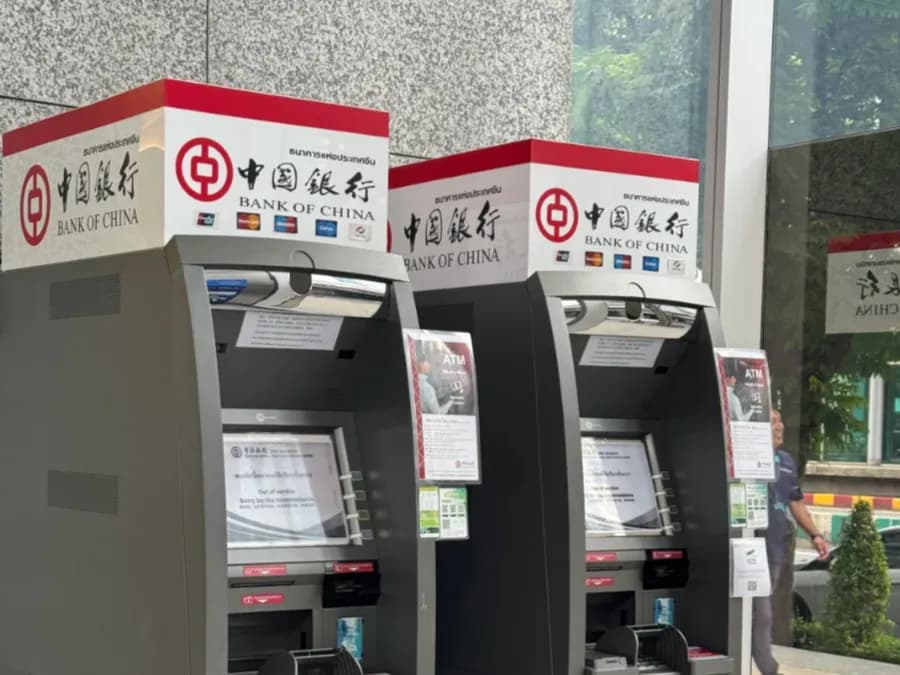
Many ATMs operated by Chinese banks support selected international card networks, including Visa, Mastercard, and UnionPay. Some machines also support other networks, depending on the bank and location.
Acceptance is not universal, so check the logos displayed on the ATM and confirm overseas cash withdrawal access with your card issuer before departure.
Check Your Bank Card Before Traveling
Before leaving home, confirm that your card:
Supports international cash withdrawals.
Is enabled for use in mainland China.
Has a PIN that works for ATM transactions.
Has sufficient available funds or credit.
Has daily cash withdrawal limits suitable for your needs.
Ask your issuing bank about foreign ATM fees, currency conversion charges, and any restrictions on overseas withdrawals.
If your card supports ATM withdrawals only through a particular network, look for ATMs displaying that network's logo.
Find a Compatible ATM
ATMs are available in many airports, bank branches, shopping areas, and urban locations.
For added convenience, start with an ATM at a bank branch, particularly if you are unfamiliar with the area. Staff may be available to help if a transaction fails or the machine retains your card.
Check the machine for the payment network logos corresponding to your card.
Do not assume that every ATM accepts every international card, even if the machine belongs to a major Chinese bank.
Insert Your Card and Select a Language
Insert your card or follow the machine's instructions if it supports cardless or contactless access.
Select English if available. Enter your PIN and choose the cash withdrawal option.
The exact screen layout and wording vary by bank and ATM model.
If the ATM asks whether you want to withdraw from a checking or savings account, select the account type supported by your card. If you are unsure, check with your issuing bank before traveling.
Enter the Withdrawal Amount
Enter the amount you wish to withdraw in Chinese yuan.
Foreign-issued cards may be subject to a per-transaction ATM limit. For example, Bank of China publishes a limit of CNY 3,000 per withdrawal for foreign cards on its ATM service page. Other machines or banks may apply different limits, and your own bank may impose additional restrictions.
If your requested amount exceeds the machine's limit, try a smaller amount rather than assuming your card is blocked.
Also check the daily withdrawal limit set by your issuing bank.
Review the Transaction and Collect Your Cash
Follow the on-screen instructions and review any fee or currency conversion information displayed before confirming.
Collect your cash and card, and take the receipt if one is available. Check that the amount dispensed matches your intended withdrawal.
If the transaction is declined, do not repeatedly retry large amounts. Check your bank's app or contact the issuer to determine whether the issue involves the card, the account, a security restriction, or the ATM itself.
The total cost of withdrawing cash in China can involve several different charges. Understanding them before traveling makes it easier to compare ATM withdrawals with exchanging physical cash.
Foreign ATM Withdrawal Fees
Your home bank may charge a fixed fee for each overseas ATM withdrawal, a percentage of the amount withdrawn, or both.
For example, if your bank charges a fixed fee per transaction, making several small withdrawals may cost more than making one larger withdrawal.
However, withdrawing more cash at once also increases the amount you carry and the risk of loss or theft. Balance convenience, cost, and personal safety.
ATM Operator Fees
The ATM operator may apply its own transaction fee. Whether such a fee applies, and how it is disclosed, depends on the machine and transaction.
Read any fee notice before proceeding. If the charge is unclear or unexpectedly high, cancel and consider another ATM.
Currency Conversion Fees
When you withdraw CNY using a foreign-currency account, the transaction must be converted into your account's currency.
Your card network, card issuer, or another party involved in processing the transaction may determine the exchange rate and applicable conversion charges.
Your bank may also apply a foreign transaction fee. Check your card's fee schedule rather than assuming that the advertised exchange rate is the final rate you will receive.
Dynamic Currency Conversion
Some ATMs may offer to process a withdrawal using your home currency instead of Chinese yuan.
This is known as dynamic currency conversion (DCC). It allows you to see an amount in your home currency, but the exchange rate may be less favorable than the rate available through your card network or issuer.
When offered a choice, compare the displayed rate and fees carefully. If you do not want the ATM to convert the transaction into your home currency, choose to proceed in CNY or decline the conversion, if that option is available.
Important: Choosing CNY does not eliminate all fees. Your own bank or card network may still apply its normal conversion rate and charges.
Neither method is always the cheapest. The right option depends on your card's fees, the cash exchange rate, and how much money you need.
| Factor | Currency Exchange | ATM Withdrawal |
|---|---|---|
| What you need | Foreign banknotes or another accepted payment method | Compatible international bank card |
| Main costs | Exchange-rate margin and possible service fee | ATM fee, issuer fee, and conversion costs |
| Convenience | Depends on location and opening hours | Often convenient in urban areas |
| Identification | May be required | Usually requires card authentication; rules vary |
| Main limitation | Currency availability and provider rates | Network compatibility and withdrawal limits |
| Best use | Travelers bringing foreign cash | Travelers with a suitable low-fee bank card |
When Currency Exchange Makes More Sense
Exchanging foreign cash may be preferable if your bank charges high overseas withdrawal fees, your card is not compatible with local ATMs, or you already have cash in an accepted currency.
It can also provide a backup if your card is lost, blocked, or temporarily unavailable.
When ATM Withdrawal Makes More Sense
An ATM may be a better choice if your bank offers low-cost international withdrawals, you prefer not to carry large amounts of foreign cash, and you can find a compatible machine.
It is especially convenient when you need additional yuan during your trip.
A Simple Way to Compare the Cost
Suppose you want to obtain CNY 2,000. Compare the total amount you would pay in your home currency under each option.
Currency exchange: Cost of foreign cash at the provider's quoted rate, including all exchange fees.
ATM withdrawal: The converted value of CNY 2,000, plus the ATM operator's fee, your bank's withdrawal fee, and any applicable conversion charges.
Choose the method with the lower total cost, provided it is practical and secure.
Do not compare an advertised exchange rate with an ATM transaction that includes additional fees. Compare the final amount paid for the same amount of CNY.
For many travelers, a combination of methods is more practical than relying on only one.
Bring a Small Amount of Cash
Having some yuan available when you arrive can help you manage immediate expenses before you have located an ATM or completed your payment setup.
You can exchange a small amount before departure or obtain cash after landing, depending on the rates and services available to you.
Use a Low-Fee Card for Additional Cash
If your bank card supports international ATM withdrawals, it may be a convenient way to obtain more cash during your stay.
Check your bank's fees and withdrawal limits in advance, and carry a backup card if possible.
Keep a Mobile Payment Option Ready
Mobile payments are widely used in mainland China. International visitors may be able to link eligible foreign-issued cards to services such as Alipay or Weixin Pay (WeChat Pay), subject to the platform's verification requirements, supported card networks, and applicable fees.
Mobile payments can reduce the need to carry large amounts of cash, but they should not be your only backup. Some transactions or merchants may not support your particular setup.
Avoid Carrying Your Entire Budget in Cash
Carrying a large amount of cash increases the consequences of theft or loss. Keep the cash you need for daily spending separate from your passport, backup bank card, and other valuables.
If you plan to bring substantial amounts of currency across the border, check the latest Chinese customs declaration rules and any requirements imposed by your departure country.
Yes, international visitors can withdraw Chinese yuan at compatible ATMs using supported foreign-issued bank cards. However, acceptance depends on the ATM, the card network, the issuing bank, and any applicable restrictions.
Common international networks include Visa, Mastercard, and UnionPay. Some institutions support additional networks, such as JCB or American Express.
Before departure, verify the following:
Your card network is supported by the ATM you intend to use.
Your card is enabled for overseas ATM withdrawals.
Your PIN and account type are compatible with ATM transactions.
Your bank has not imposed a regional or security restriction.
You know your daily cash withdrawal limit and applicable fees.
If you are traveling to smaller cities or rural areas, it is especially important to carry a backup payment method. ATM availability and international card acceptance can vary by location.
Even a compatible bank card may occasionally fail at an ATM. Here are some common issues and practical ways to respond.
Your Card Is Declined
Possible causes include insufficient funds, a withdrawal limit, a blocked card, a network issue, or an unsupported card type.
What to do:
Check your account balance and withdrawal limit.
Confirm that overseas cash withdrawals are enabled.
Try a smaller amount.
Use an ATM displaying your card's network logo.
Contact your issuing bank if the problem continues.
The ATM Does Not Display English
Some machines provide a language selection screen, while others may offer limited language support.
What to do: Look for an English-language option before entering your PIN. If you cannot understand the prompts, cancel the transaction rather than guessing. Try a machine at a larger bank branch where assistance may be available.
The ATM Rejects Your PIN
Some cards have separate PIN or transaction requirements for cash withdrawals.
What to do: Stop if your PIN is rejected repeatedly. Confirm the correct ATM PIN with your card issuer before trying again. Repeated incorrect attempts can result in your card being blocked or retained.
The ATM Retains Your Card
A machine may retain a card because of repeated PIN errors, a technical problem, or a security rule.
What to do: Contact the bank branch or ATM operator immediately and follow their instructions. If the ATM is associated with a Bank of China branch, its published guidance directs customers whose cards are retained to contact branch staff or call its customer service hotline at 95566.
If the card cannot be recovered promptly, contact your home bank to lock or replace it as appropriate.
Your Account Is Debited but No Cash Comes Out
A failed or interrupted ATM transaction may require investigation before the funds are released or refunded.
What to do: Keep the receipt if available, note the ATM location and transaction time, and check your account for the transaction status. Contact the ATM operator and your issuing bank. Avoid immediately repeating the same large withdrawal until you understand what happened.
There is no single amount that suits every traveler. Your cash needs depend on your itinerary, accommodation arrangements, preferred payment methods, and access to compatible ATMs.
A practical approach is to carry enough yuan for immediate purchases and unexpected payment problems, while using cards or supported mobile payment services for other expenses.
Consider your likely spending on:
Local transportation.
Small restaurants and shops.
Markets and street vendors.
Small purchases where card acceptance is uncertain.
Emergencies or temporary payment disruptions.
Keep smaller banknotes for everyday transactions and change where possible. A ¥100 note can be inconvenient for a very small purchase if the merchant has limited change available.
Before departure, also check the rules for carrying RMB across China's borders. Official Chinese guidance states that the general limit for carrying RMB cash into or out of China is CNY 20,000 per person per trip. Confirm the current rules and any relevant declaration requirements before traveling, especially if carrying larger sums or multiple currencies.
Compare the Final Amount, Not Just the Advertised Rate
A provider advertising a competitive exchange rate may charge a separate service fee. Ask how much yuan you will receive after all charges.
Check Your Bank's Overseas Fee Schedule
A card with no foreign transaction fee may still incur ATM operator charges. Conversely, a card with a fixed withdrawal fee may be economical for a suitably sized transaction.
Read the full fee schedule before deciding how to obtain cash.
Avoid Unnecessary Currency Conversion
If an ATM offers to convert your withdrawal into your home currency, review the rate carefully. Choosing CNY instead may allow your card issuer or network to handle the conversion, but the final rate and fees depend on your card agreement.
Use Official or Authorized Providers
Choose recognized bank branches, authorized exchange counters, and legitimate ATMs. Avoid informal street exchanges and anyone who asks to take your card away from you.
Keep Receipts for Larger Transactions
Receipts can help you check the amount received, understand fees, and resolve disputes with a provider or bank.
Prepare Before Arrival
Save your bank's international support number, enable transaction alerts if available, and confirm your card's international withdrawal settings. These steps are easier to complete before a card problem occurs overseas.
Can I exchange US dollars for Chinese yuan in China?
Yes. US dollars are among the foreign currencies that may be exchanged at eligible banks and authorized exchange providers. Availability, accepted banknote conditions, exchange rates, and service fees vary by provider.
Can I withdraw Chinese yuan using a Visa or Mastercard?
Yes, if your card is enabled for international ATM withdrawals and the machine supports the relevant network. Check the ATM logos and your card issuer's overseas withdrawal rules before traveling.
Is it cheaper to exchange money or withdraw from an ATM in China?
It depends on the exchange rate and fees. An ATM may be cheaper with a low-fee travel card, while exchanging cash may be preferable if your bank charges high withdrawal fees. Compare the total cost of obtaining the same amount of yuan.
How much can I withdraw from an ATM in China?
Limits vary by ATM operator, transaction, card network, and issuing bank. Bank of China publishes a CNY 3,000 single-withdrawal limit for foreign cards on its ATM service page. Your own bank may set additional daily or monthly limits.
Do I need my passport to exchange money in China?
Identification requirements depend on the provider and transaction. Bring your passport when visiting a bank or authorized exchange counter, and confirm any additional documentation requirements before making a larger exchange.
Are ATMs available at Chinese airports?
ATMs are available at many major airports, although their locations, operating arrangements, and support for foreign cards vary. Check the airport's official website and look for compatible international card network logos.
Can I rely entirely on mobile payments in China?
Not necessarily. Mobile payments are widely used, and eligible foreign visitors may be able to link international cards to supported payment apps. However, setup, verification, fees, card eligibility, and merchant acceptance can vary. Keeping some cash and a backup card is a sensible precaution.
Can I exchange unused yuan back into my home currency?
Some banks or authorized exchange providers may offer this service, subject to applicable rules, identification requirements, and transaction documentation. Ask about the exchange rate and any restrictions before exchanging a large amount of money.
Should I exchange money at the airport or in the city?
Airport exchange is convenient when you need cash immediately. Other authorized providers or bank branches may offer different rates. Compare the total amount you will receive and choose the option that best balances cost, convenience, and opening hours.
Checked your bank card's international ATM withdrawal settings.
Confirmed the card network and overseas withdrawal fees.
Memorized or securely stored your ATM PIN.
Saved your bank's international customer service number.
Prepared a backup card or another payment method.
Identified an authorized currency exchange provider or compatible ATM near your arrival point.
Set up an eligible mobile payment option if you intend to use one.
Checked the latest currency and customs rules for your trip.
Currency exchange and ATM cash withdrawal in China are manageable once you understand the available options and their costs.
For many international visitors, the most flexible strategy is to carry a small amount of Chinese yuan, use a compatible low-fee bank card for additional cash, and prepare a supported mobile payment option for everyday purchases.
Before exchanging money or confirming an ATM transaction, compare the final cost, verify card compatibility, and use authorized providers. A little preparation can help you avoid unnecessary fees and enjoy a smoother trip across mainland China.
China's Guide to Payment Services — explains payment options for international visitors.
Shanghai Municipal Government: Foreign Currency Exchange Guide — covers authorized exchange services and ATMs.
Bank of China: ATM Service Information — describes international card support and withdrawal limits.
Rules, fees, and service availability can change. Confirm the latest information with the relevant bank, exchange provider, card issuer, or government authority before traveling.
Your journey, simplified
How We Work
From the first idea to the final day, every detail is handled with care.
Share your travel ideas
Tell us where you want to go and what you enjoy.
Meet your travel advisor
We shape a personal itinerary around your priorities.
Confirm your journey
Review every detail and reserve with confidence.
Travel with support
Our team stays available throughout your trip.
Travel expert
Contact Your Travel Specialist
Get practical advice from a local specialist and turn this route into a trip that fits you.
Start planningRelated Articles
Swipe to explore