Zhangjiajie Welcomed Tourists from 196 Countries in 2026: Why More Foreign Travelers Are Visiting
Why More Foreign Travelers Are VisitingZhangjiajie is becoming an increasingly international destination in China.
Zhangjiajie is becoming an increasingly international destination in China.
From January to August 2026, Zhangjiajie received 994,500 inbound tourist visits from 196 countries and regions, an increase of 20.47% compared with the same period last year. Tourism foreign-exchange revenue reached US$109.61 million, up 40% year on year. In August alone, the city recorded 133,800 inbound tourist visits, an increase of 30.79%.

The numbers are interesting not only because more international visitors are arriving, but because the composition of those visitors is changing. South Korea remains Zhangjiajie's largest overseas source market, while visitors from the United States, Russia, Italy, the United Kingdom and other long-haul markets are growing rapidly. At the same time, independent travel is becoming much more common.
For travelers planning a China trip in 2026, this raises a useful question: what is changing in Zhangjiajie, and what does it mean for foreign tourists?
Zhangjiajie has long been particularly popular with visitors from nearby Asian markets, especially South Korea. That market remains extremely important in 2026.
During the first eight months of the year, South Korean visitors accounted for 204,600 inbound tourist visits, making South Korea Zhangjiajie's largest international source market.
But the bigger story is what is happening beyond the traditional markets.
According to data from the Zhangjiajie Smart Tourism Platform, visitors came from 196 countries and regions between January and August. The top ten source markets were South Korea, the United States, China's Taiwan, Russia, China's Hong Kong, Malaysia, Indonesia, Singapore, Italy and Vietnam.
| Market | January-August 2026 | Year-on-Year Change |
|---|---|---|
| South Korea | 204,600 | Largest inbound source market |
| United States | 111,800 | +162.02% |
| Russia | 71,200 | +219.11% |
| Italy | 37,600 | +97.88% |
| United Kingdom | 22,100 | +207.24% |
| Germany | 14,600 | +18.35% |
These figures show why Zhangjiajie's international tourism market is no longer defined by one or two major source countries. Long-haul markets in Europe and North America are becoming a much more visible part of the city's visitor mix.
There is no single reason for the growth. Zhangjiajie has several characteristics that work particularly well for international travelers looking for something different from China's major historic cities.
The landscape is the obvious starting point.
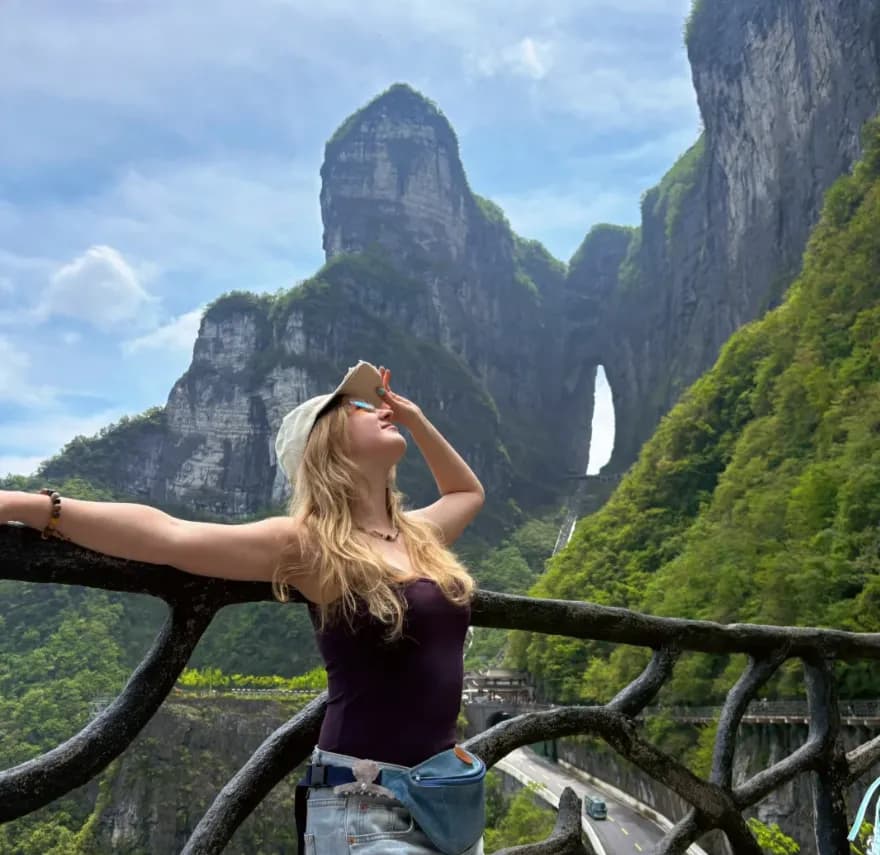
The towering sandstone formations around Wulingyuan look very different from the classical Chinese gardens of Suzhou, the historic streets of Xi'an, or the urban skyline of Shanghai. For travelers who want mountains, forests, hiking trails, viewpoints and dramatic photography, Zhangjiajie offers a very different side of China.
The city's international visibility has also been helped by the association between its landscape and the floating mountains shown in the film Avatar. That connection has introduced Zhangjiajie's scenery to audiences who may not previously have known where it was.
At the same time, Zhangjiajie has continued to develop transportation and visitor services for overseas travelers. Earlier in 2026, official data showed that inbound tourism had already reached 860,700 visits from 195 countries and regions in the first seven months. European and American visitors accounted for 34.43% of that total during the period, with their number increasing 211.36% year on year.
This suggests that the growth in European and American visitors is not simply a one-month spike. It has been visible throughout 2026.
The United States stands out in the latest figures.
From January to August 2026, Zhangjiajie received 111,800 American tourist visits, representing a year-on-year increase of 162.02%. That makes the United States the city's second-largest inbound source market in the latest ranking, behind South Korea.
For American travelers planning a first trip to China, Zhangjiajie can work particularly well as part of a larger itinerary rather than as a standalone destination.
A common approach is to combine Beijing or Shanghai → Zhangjiajie → Xi'an or Chengdu, depending on the rest of the trip. Travelers who have more time can add Fenghuang Ancient Town and other destinations in western Hunan.
The important thing is to allow enough time for Zhangjiajie itself. The main scenic areas are spread across a large mountainous region, and seeing the highlights properly is not something that can realistically be squeezed into a few hours.
Russia recorded an even sharper increase.
Zhangjiajie received approximately 71,200 Russian tourist visits from January to August, an increase of 219.11% year on year. That makes Russia one of the fastest-growing major inbound markets in the city.
The growth of Russian visitors is part of the broader expansion of Zhangjiajie's international visitor base beyond East and Southeast Asia.
Italy and the United Kingdom also recorded substantial increases. Italian visitors reached 37,600, up 97.88%, while British visitors reached 22,100, up 207.24%. German visitors totaled 14,600, representing an 18.35% increase.
For a destination historically associated with Asian group tours, this is an important change. Zhangjiajie is increasingly attracting travelers from markets where independent travel, photography, hiking and personalized itineraries are common travel preferences.
Perhaps the most useful statistic for travelers is not the number of visitors from individual countries. It is the growth of independent tourists.
In August 2026, independent tourist visits in Zhangjiajie increased by 129.49% year on year. For the January-August period, the number of independent travelers increased by 36.56% compared with the same period in 2025.
That means Zhangjiajie's international tourism scene is changing in a practical way.
More foreign visitors are no longer simply arriving as part of large organized groups. They are researching attractions themselves, choosing their own hotels, buying train tickets, deciding how long to stay and combining Zhangjiajie with other destinations in China.
For independent travelers, this creates a different set of questions:
How many days do you need in Zhangjiajie?
Which scenic area should you visit first?
Where should you stay?
How do you travel between the railway station, hotels and scenic areas?
Is Zhangjiajie suitable without a Chinese-speaking guide?
These practical details are becoming increasingly important as the city's international visitor base grows.
Zhangjiajie is not one single attraction. The three major scenic areas—Wulingyuan, Tianmen Mountain and Zhangjiajie Grand Canyon—offer noticeably different experiences.
| Scenic Area | Best Known For | Good For |
|---|---|---|
| Wulingyuan Scenic Area | Sandstone peaks, forests, valleys and viewpoints | Nature, hiking, photography and first-time visitors |
| Tianmen Mountain | Cable car, mountain roads, glass walkways and Tianmen Cave | Shorter visits, dramatic viewpoints and adventure |
| Zhangjiajie Grand Canyon | Mountain scenery, canyon landscapes and glass bridge | Adventure activities and independent travelers |
If someone says "Zhangjiajie mountains," they are usually thinking about the landscape around Wulingyuan.
The area is famous for its enormous sandstone pillars rising from forested valleys. Rather than being one viewpoint, Wulingyuan is a large scenic area containing multiple sections and sightseeing routes.
For first-time foreign visitors, it is worth allowing at least two days for the major sights rather than trying to rush through everything in a single day.
The combination of mountain viewpoints, forest paths, streams and cableways also means you can adjust the experience to your fitness level. Some visitors prefer long walks, while others can use cable cars, elevators and shuttle buses to reduce the amount of climbing.
Zhangjiajie National Forest Park has also been improving services for international tourists, including multilingual guidance and self-service ticketing. In 2025, the park reported foreign visitors from 161 countries and regions during the first seven months of that year.
Tianmen Mountain is different from Wulingyuan in both geography and sightseeing style.
Instead of spending most of the day walking through a huge forest park, visitors can use the famous cable car to climb from the city toward the mountain. The attraction is known for its steep mountain landscape, high-altitude walkways, Tianmen Cave and dramatic road views.
The data from 2026 shows that independent tourists account for nearly half of visitors at Tianmen Mountain Scenic Area. That is consistent with the wider shift toward travelers planning their own Zhangjiajie experiences rather than relying entirely on group tours.
If you have only one full day for a major Zhangjiajie attraction, Tianmen Mountain can be easier to organize than trying to cover the much larger Wulingyuan area.
Zhangjiajie Grand Canyon has developed its own international visitor profile.
According to the latest tourism data, overseas visitors account for more than half of the total visitors at Zhangjiajie Grand Canyon Scenic Area. This makes it one of the places in Zhangjiajie where international travelers are particularly visible.
The glass bridge is the attraction most familiar to many overseas visitors, but the canyon itself is worth considering as more than a photo opportunity.
Travelers interested in adventure tourism can also find activities beyond conventional sightseeing. Zhangjiajie has been expanding outdoor experiences in recent years, including via ferrata and other adventure-oriented activities.
When a destination receives more international visitors, the change is not visible only in visitor statistics.
You may notice more foreign-language signs, more international payment options, multilingual information and more tourism workers accustomed to serving overseas guests.
Zhangjiajie has been working on these areas as part of its inbound tourism development. Official reports have highlighted improvements in transportation, accommodation, dining and payment services for international visitors.
There is still a practical limitation worth understanding: Zhangjiajie is an international tourist destination, but it is not an entirely English-speaking environment.
Major scenic areas and hotels are increasingly accustomed to foreign visitors, while smaller restaurants, local transportation services and rural attractions may offer much less English support. Having your hotel address and destination names saved in Chinese can still be useful even if you do not speak Chinese.
For most first-time international visitors, three to four days is a comfortable starting point.
A three-day trip could focus on one full day in Wulingyuan, one day for another section of the national park or nearby attractions, and one day for Tianmen Mountain or another major experience.
With four or five days, the itinerary becomes much more relaxed. You can add Zhangjiajie Grand Canyon, Furong Town, Fenghuang Ancient Town or other destinations in western Hunan.
| Trip Length | Possible Focus |
|---|---|
| 2 days | Tianmen Mountain + a focused visit to Wulingyuan |
| 3 days | Wulingyuan + Tianmen Mountain |
| 4 days | Wulingyuan + Tianmen Mountain + Zhangjiajie Grand Canyon |
| 5–6 days | Zhangjiajie + Grand Canyon + Fenghuang or Furong Town |
The exact plan should depend on your arrival and departure times. Zhangjiajie's scenic areas are not all located beside the same transport hub, so adding more attractions does not always mean a better trip.
Yes, and the rapid growth of independent visitors in 2026 is itself evidence that more travelers are choosing this approach.
But independent travel does not mean you should arrive without preparation.
Before leaving for Zhangjiajie, check the opening hours and ticket rules for each scenic area, confirm which railway station or airport you are using, and understand how you will reach your hotel after arrival.
For the mountain attractions, also check the weather forecast. Fog, rain and cloud can dramatically change the visibility of the landscape. A cloudy day is not necessarily a bad day—mist can make the mountains look atmospheric—but it can affect long-distance views and photography.
One of the most interesting extensions to a Zhangjiajie trip is Fenghuang Ancient Town in western Hunan.
The two destinations complement each other well. Zhangjiajie is primarily about mountains, forests and outdoor scenery, while Fenghuang is known for its historic riverside architecture, bridges, narrow streets and cultural atmosphere.
Instead of returning immediately to a major Chinese city after visiting Zhangjiajie, travelers with enough time can continue through western Hunan and build a more regional itinerary.
This also fits the current development of the Zhangjiajie-Jishou-Huaihua high-speed railway corridor, which has made travel across western Hunan more convenient.
The growth from Europe and North America is particularly important because long-haul travelers often have different expectations from short-haul group-tour markets.
They may stay longer, combine several Chinese destinations, search extensively online before traveling, and prefer flexible itineraries that allow them to spend more time photographing, hiking or simply experiencing a place.
The sharp rise in independent travel suggests that Zhangjiajie is increasingly being discovered through this kind of traveler behavior.
For a destination built around spectacular natural scenery, that can be a good match. Mountains are something travelers often want to experience at their own pace rather than rush through as one stop on a large tour.
The 2026 numbers are part of a broader recovery and expansion in Zhangjiajie's international tourism market.
From January to April 2026, the city had already recorded 326,700 inbound tourist visits, with visitors from Europe and the United States accounting for 35.42% of the total during that period. The number of visitors from those markets increased 123.43% year on year.
By the end of August, the number of inbound tourist visits had reached 994,500, while the number of source countries and regions had expanded to 196.
That progression matters more than any single monthly figure. It suggests that Zhangjiajie's international market is becoming broader rather than simply recovering in one traditional market.
If you are considering Zhangjiajie for an upcoming China trip, the latest visitor data gives you a useful picture of the destination.
You will not be traveling to a place that is unknown to international tourists. South Korean visitors have been coming in large numbers for years, and the city is now seeing substantial growth from the United States, Russia, Italy, the United Kingdom, Germany and other European and American markets.
At the same time, the growth of independent travel means that you can increasingly plan Zhangjiajie yourself rather than assuming that a package tour is necessary.
The basic formula is relatively simple: choose your main scenic areas, allow enough days, book transportation in advance during busy periods, prepare for local transfers, and leave some flexibility for mountain weather.
How many foreign tourists visited Zhangjiajie in 2026?
From January to August 2026, Zhangjiajie recorded 994,500 inbound tourist visits from 196 countries and regions, according to data from the Zhangjiajie Smart Tourism Platform reported by the Hunan Provincial Government.
Which country sends the most tourists to Zhangjiajie?
South Korea remained Zhangjiajie's largest inbound source market during January-August 2026, with 204,600 tourist visits.
Are more Americans visiting Zhangjiajie?
Yes. Zhangjiajie received 111,800 American tourist visits during January-August 2026, up 162.02% year on year.
Is independent travel to Zhangjiajie becoming more popular?
Yes. Independent tourist visits increased 36.56% year on year during January-August 2026 and rose 129.49% year on year in August alone.
What are the main scenic areas in Zhangjiajie?
The three major core scenic areas highlighted in the latest inbound tourism data are Wulingyuan, Tianmen Mountain and Zhangjiajie Grand Canyon. Each offers a different experience, from large-scale mountain landscapes to high-altitude viewpoints and adventure attractions.
How long should I stay in Zhangjiajie?
Three to four days is a practical starting point for a first visit, while five or more days gives you enough time to add attractions such as Zhangjiajie Grand Canyon, Fenghuang Ancient Town or Furong Town without making the itinerary too rushed.
The city is attracting travelers from more places, particularly from long-haul markets. South Korea remains its largest source market, but the rapid growth of visitors from the United States, Russia, Italy and the United Kingdom is changing the international profile of the destination.
Perhaps even more important is the rise of independent travel. Travelers are increasingly coming to Zhangjiajie on their own terms—choosing their routes, deciding how long to stay and combining the mountains with other destinations in Hunan and China.
For anyone planning a China trip in 2026, that makes Zhangjiajie worth looking at not simply as the home of the famous "Avatar mountains," but as one of China's increasingly accessible international nature destinations.
The numbers tell one part of the story. The more interesting part is what happens when you leave the cable car station, walk into the mountains, and realize that the landscape that brought you to Zhangjiajie is much larger than the photograph you first saw online.
Your journey, simplified
How We Work
From the first idea to the final day, every detail is handled with care.
Share your travel ideas
Tell us where you want to go and what you enjoy.
Meet your travel advisor
We shape a personal itinerary around your priorities.
Confirm your journey
Review every detail and reserve with confidence.
Travel with support
Our team stays available throughout your trip.
Travel expert
Contact Your Travel Specialist
Get practical advice from a local specialist and turn this route into a trip that fits you.
Start planningRelated Articles
Swipe to explore